The Sneaker You Paid $30 For Might Last 300 Years in the Ground

Fast fashion came for footwear — and the landfills are keeping score.
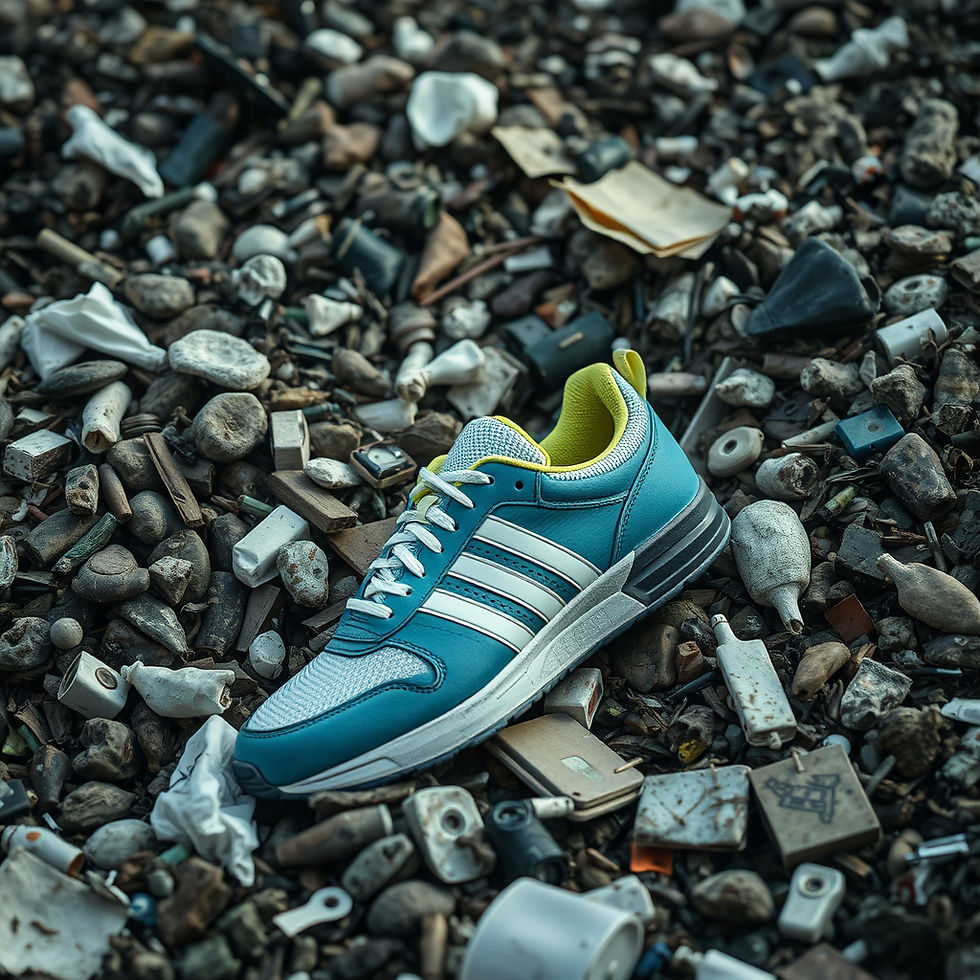
There's a sneaker sitting in a landfill right now that was bought on sale for $29.99, worn maybe six times, and tossed when the sole started peeling. It's been there for three years. It will be there for another 30 to 40, doing nothing but slowly off-gassing synthetic materials into the soil.
Multiply that by hundreds of millions of pairs a year. That's not a metaphor. That's the current math.
The conversation about fashion's waste crisis usually centers on clothing — the fast-fashion brands pumping out trend cycles at a speed that makes seasonality irrelevant, the garments that get worn once and discarded. Footwear gets a pass in most of these conversations, maybe because shoes feel more durable, more permanent, more like an investment. But the fast fashion model has colonized sneakers as completely as it has everything else — and the waste infrastructure that sneakers require doesn't exist yet at scale.
What's Actually in a Sneaker
Before we talk about the waste problem, it helps to understand why sneakers are so hard to deal with at end-of-life.
A modern athletic sneaker is not one material. It's a composite system: a rubber outsole, a foam midsole (EVA, polyurethane, or proprietary compounds like Nike's React or Adidas's Boost), a textile or synthetic leather upper, mesh overlays, plastic hardware, reflective details, glue — lots of glue — and often a combination of dyes and coatings that would make a chemist reach for a chart.
Each layer is designed to work together. They are emphatically not designed to come apart.
That's the core problem. Recycling is, at its most basic, the process of separating materials so they can be reprocessed into something new. Sneakers resist separation. The adhesives that make a shoe feel solid and finished are the same adhesives that make disassembly enormously labor-intensive. When a sneaker ends up in a general waste stream, it goes to landfill almost by default — because the alternative requires specialized processing that few programs have the scale or funding to run.
Nike's Grind program, launched decades ago, grinds worn-out athletic shoes into material used for sports surfaces. Adidas has partnered with Parley on ocean plastic initiatives and developed recyclable midsole concepts. On Running released a shoe designed for circular use — lease it, wear it out, send it back. These are real innovations, and they matter.
They are also, in the context of 24 billion pairs produced annually worldwide, a rounding error.
The Fast Fashion Acceleration
Here's where the problem compounds: the same forces that created the clothing waste crisis are now fully operational in footwear.
Brands that historically released two or three footwear lines a year now release dozens of micro-collections, trend-adjacent colorways, and fast-cycle basics that are designed to feel current for a season and replaceable shortly after. The price point that makes it easy to justify a spontaneous purchase — $30, $40, $50 — is also the price point that makes it easy to throw something away without guilt when it starts to show wear.
The economic logic of disposability works in both directions. Cheap enough to buy on impulse. Cheap enough to discard without regret. But the materials that make up even a $30 sneaker don't get cheaper to process just because the shoe was cheaper to buy. They still end up in the same landfill, taking up the same amount of space, for the same 30 to 40 years.
What fast fashion footwear has done is dramatically increase the volume of pairs entering the waste stream while simultaneously decreasing the average quality — and therefore the useful life — of the individual shoe. More pairs. Less durability. More turnover. More waste.
The Part Sneaker Culture Actually Gets Right
Here's a thing that doesn't get said enough in these conversations: sneaker culture, at its core, is actually a conservation movement.
The people who hunt for vintage pairs, restore worn soles, customize aging uppers, resell gently used Jordans, and debate the comparative durability of Primeknit versus mesh — these are people who understand that a good shoe has a long life if you're willing to care for it. The sneakerhead who has a rotation of 40 pairs and wears every single one is keeping 40 pairs out of the landfill. The collector who chases deadstock isn't just buying hype — they're preserving a physical artifact.
The problem isn't enthusiast culture. It's the mass market sitting beneath it, churning through volume without any of the reverence.
The solution has to work at both levels. Enthusiast culture needs better infrastructure for the pairs that genuinely can't be resold or restored — programs that can handle material recovery responsibly rather than routing unusable pairs to general waste. The mass market needs on-ramps to the practices that enthusiast culture takes for granted: buy better, wear longer, donate intentionally, understand that a shoe isn't finished when you're finished with it.
That's the whole premise behind The Cycle. Free pickup. Honest routing. Wearable pairs back into circulation. Non-wearable pairs handled with material recovery in mind.
The sneaker you paid $30 for might last 300 years in the ground. The question is whether it has to.
Want to keep your old pairs out of the landfill? Schedule a free recycling pickup → or donate by mail →
Every purchase at SneaksGeeks fuels the 30/35/35 Pledge: 30% reinvested in the brand, 35% recycled or repurposed, 35% donated to communities in need. Built Different.

Comments